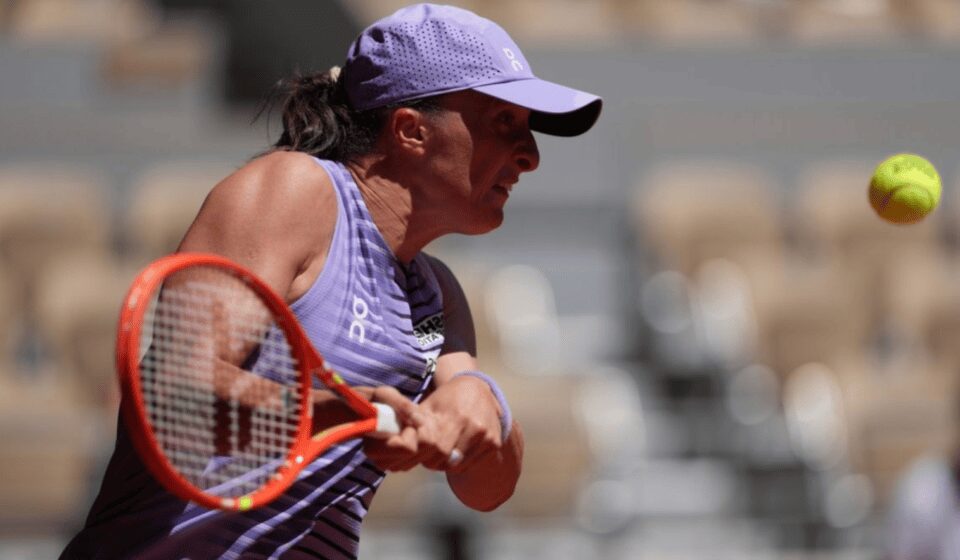
Swiatek Grinds Past Bejlek at Roland Garros 2026 to Set Up Tense All-Polish Clash With Linette

When you watch Iga Swiatek play on clay, you expect dominance. You expect long rallies cut short by a forehand that seems to come from a different sport. What you do not expect is 38 unforced errors, six double faults, and a first set that drags on for 46 minutes. That is exactly what Court Philippe-Chatrier served up on May 27, 2026, as Swiatek pushed past Czech qualifier Sara Bejlek 6-2, 6-3 to reach the Roland Garros 2026 third round.
The scoreline tells one story. The match told a different one, at least for stretches. And that gap between what the scoreboard shows and what actually happened on court is where the most interesting part of Swiatek’s Roland Garros 2026 campaign currently lives.
I have followed Swiatek’s clay season closely over the past three years. Watching her absorb a poor serving day, a string of errors, and a younger opponent willing to mix things up, and still walk away in straight sets is something that never gets old. It is a different kind of impressive. Not the highlight reel version, but the grind-it-out, come-back-when-it-matters version that separates good players from great ones.
What Actually Happened in the Match
Swiatek opened her serve and held without drama. Then things got complicated. Bejlek, the world number 35 who had already taken out former US Open champion Sloane Stephens in the first round, was not there to make up the numbers. She broke back immediately, levelled the first set, and showed from the opening games that she was not going to be passive.
The first set stretched to 46 minutes, which is a long time in a set that Swiatek won 6-2. She was broken twice. Her first serve went in just 37 percent of the time. Even the second set opened with a single game that lasted nearly 10 minutes. By the time Swiatek held to lead 1-0 in set two, the clock had already crossed the one-hour mark.
And yet, here is what makes Swiatek so hard to beat even on days like this. She broke Bejlek seven times across the match. She won eight of her 11 points at the net. When she needed to raise her level, she did it, broke straight back after being pegged level, and eventually closed out the match in one hour and 31 minutes according to some reports, and one hour and 34 minutes according to others, with both figures appearing in official coverage.
Swiatek finished with 38 unforced errors compared to 17 winners. On paper, that looks bad. On clay at Roland Garros, against an opponent who mixed pace, spin, and trajectory deliberately to disrupt Swiatek’s timing, it looks a little more understandable. Swiatek herself acknowledged after the match that Bejlek’s game was genuinely tricky to read.
“She has a tricky style of game. She mixes up the rhythm quite well. I’m really happy with how focused I stayed from the first point. Every round here requires total concentration, especially against young players who have nothing to lose.”
That quote matters. Swiatek was not dismissing the difficulty. She was acknowledging it while also explaining how she managed it. Total focus from the first point is not easy to maintain when your serve keeps letting you down and your forehand keeps finding the net. She did it anyway.
Why Bejlek Deserves More Credit Than She Gets
Most of the post-match coverage focused on Swiatek’s errors. Fair enough. But Bejlek did something real here. She is 20 years old, ranked 35 in the world, and she competed from start to finish against one of the best clay court players in tennis history.
Her ball-striking patterns were varied enough to cause genuine problems. Swiatek noted after the match that from similar swing shapes, Bejlek would play flat one moment and then produce something completely different the next. “Pretty unpredictable, I would say,” was how Swiatek put it.
On a clay court, where players typically have time to read the ball off the surface and adjust, that unpredictability is a real weapon. Bejlek used it well. She did not just push the ball back and hope for errors. She was proactive, moved Swiatek around, and forced the Pole into longer rallies than she wanted.
The 20-year-old was also effective defensively. She got to balls that many players at her ranking would have conceded, and she kept points alive long enough to create doubt. The problem, ultimately, was that Swiatek’s ceiling on clay is simply too high. When Swiatek decided a point needed to end, it ended. When she needed to serve and hold at a critical moment, she found a way. Bejlek could compete but she could not match Swiatek’s ability to shift gears when the match required it.
The Number That Puts Everything Into Context
Swiatek’s 6-2, 6-3 win was her 42nd victory in her first 45 main draw matches at Roland Garros. That number is significant because it ties the Open Era record that Chris Evert held for decades.
Think about what that means. Chris Evert won Roland Garros seven times. She is one of the greatest clay court players the sport has ever seen. And Swiatek, at 24 years old, has matched Evert’s record for the best start in the Open Era at this tournament. She has now won four Roland Garros titles herself, in 2020, 2022, 2023, and 2024. She reached the semi-final in 2025 before losing to Aryna Sabalenka.
The win also extended several other streaks worth noting. It was her eighth consecutive third-round appearance at Roland Garros. It was her 20th win of the 2026 season. And it brought her record against unseeded opponents at this tournament to 27-0. Not 27 wins. 27-0. She has never lost to an unseeded player at Roland Garros. Every single time she has faced someone without a seed in Paris, she has won.
That kind of consistency over that kind of stretch, on one of the most demanding surfaces in tennis, puts Swiatek in a category with very few players in the history of the sport.
View this post on Instagram
How Swiatek’s Preparation Changed for 2026
Before getting into what comes next in the draw, it is worth spending a moment on how Swiatek arrived at Roland Garros 2026. She made a significant coaching change during the clay season, teaming up with Francisco Roig, the Spanish coach who spent years working alongside Rafael Nadal.
Roig brings a very specific set of experiences to the relationship. He was part of the team that helped shape one of the greatest clay court careers in tennis history. Whether that connection translates directly into technical improvements for Swiatek remains to be seen, but the psychological and tactical knowledge he carries from working with Nadal on clay is not nothing.
Swiatek also spent time preparing in Mallorca ahead of the clay season, training at Nadal’s academy. She talked about that experience after her first-round win. “I spent a week in Mallorca, which is amazing, because starting the clay-court season there gave me a lot of motivation,” she said.
The Bejlek match was not a showcase of what a refreshed, better-prepared Swiatek looks like. But those performances come later in tournaments, when the pressure increases and the opponents get better. Swiatek’s pattern at Roland Garros has historically been to grow into the fortnight, not to peak in round two.
The Ostapenko Factor That Went Away
When Swiatek was watching the other draws come through on Wednesday, she was paying close attention to one match in particular: Jelena Ostapenko against Magda Linette.
Ostapenko had been a potential third-round opponent, and she carries a 6-0 head-to-head record against Swiatek on the WTA Tour. That includes a clay-court win in Stuttgart in 2025. For all of Swiatek’s dominance on clay, Ostapenko’s flat, aggressive ball-striking has historically caused her serious problems. The Latvian hits through the court in a way that disrupts Swiatek’s ability to dictate with topspin. Having her in the third round would have been a genuine threat.
Instead, Linette won their match 6-2, 2-6, 6-2, removing the Ostapenko threat entirely and replacing it with a different kind of complication: a fellow Pole, someone Swiatek knows well, and someone who has already beaten her once this season.
Swiatek vs Linette: An All-Polish Collision at Roland Garros
This was the first all-Polish meeting in Roland Garros history. That alone made it a special occasion, regardless of who won. But the match carried real competitive stakes beyond the national storyline.
Linette came into the third round ranked 38 in the world and carrying genuine momentum. She had already beaten Ostapenko, a former Roland Garros champion, in three sets. She had a 1-1 head-to-head record against Swiatek heading in, and the memory of her Miami Open win earlier in 2026 season was fresh.
In Miami, Linette came from a set and 1-5 down to win 1-6, 7-5, 6-3. She showed the kind of mental resilience that makes her dangerous in long matches. On clay, against Swiatek in Paris, that resilience was always going to need to be exceptional to matter.
Their previous meetings gave a complicated picture. Swiatek crushed Linette 6-1, 6-1 in Beijing in 2023. Then Linette turned the tables in Miami this year. Both previous matches were on hard courts. The Roland Garros clash was their first on clay, which shifted the surface advantage sharply toward Swiatek.
Swiatek won 6-4, 6-4 in one hour and 25 minutes, a much cleaner performance than the Bejlek match. She was behind 0-2 early in the first set, which showed Linette was not simply going to stand back and let Swiatek dictate terms. But Swiatek turned it around, won the first set comfortably, and controlled the second despite a brief Linette comeback at 4-1 down. The fourth round awaits, where Marta Kostyuk, a player on a 14-match clay winning streak entering Roland Garros, waits as the next challenge.
Swiatek’s Roland Garros 2026 Path So Far and What to Watch
Let us put Swiatek’s 2026 Roland Garros campaign in order so far. She opened with a 6-1, 6-2 win over Australian wildcard Emerson Jones, a 17-year-old making her Grand Slam debut. That was smooth, efficient tennis with none of the rough edges that showed up in the Bejlek match.
Round two brought the Bejlek complications described above. Round three brought the all-Polish clash with Linette, which Swiatek navigated cleanly. Three rounds in, she has not dropped a set. The scorelines suggest control. The match content against Bejlek suggested she is still finding her sharpest form.
The fourth round against Kostyuk will be the biggest test yet. Kostyuk has been in outstanding form on clay. Her 14-match unbeaten run on the surface before arriving in Paris is not a small number. She hits the ball flat and early, similar in some ways to Ostapenko though with different strengths, and she is not afraid to come forward. If Swiatek’s serve continues to let her down at critical moments, Kostyuk is exactly the kind of player who can exploit it.
But Swiatek’s Roland Garros record is built on finding better tennis as the tournament progresses. Her fourth round, quarter-final, and semi-final performances at this event have historically been better than her early rounds. If that pattern holds, the version of Swiatek that shows up from round four onward could look very different from the player who struggled through 46 minutes in set one against Bejlek.
How Clay Court Tennis Works and Why Swiatek Dominates It
For readers who want to understand why Swiatek is so uniquely suited to Roland Garros, it helps to understand what clay actually does to the game.
Clay is a slow surface. The ball bounces higher and takes longer to reach the player after landing. That extra time sounds like it would make things easier, but it also means opponents have more time to recover, more time to reposition, and more time to hit aggressive shots from defensive positions. Rallies get longer. Physical fitness matters more. And topspin becomes an even more powerful weapon because the high bounce it creates is more pronounced on clay than on any other surface.
Swiatek’s forehand generates some of the heaviest topspin on the WTA Tour. When she is striking the ball cleanly, that forehand pushes opponents back behind the baseline and opens up the court for her to attack. Combined with her movement, which ranks among the best in women’s tennis, she can cover the court and absorb pressure while also dictating when rallies end.
On clay specifically, her ability to slide into wide balls and still generate pace and spin on the return is a genuine advantage. Many players have to take pace off the ball when sliding on clay. Swiatek maintains her hitting quality through the slide, which means she does not lose control of the rally just because she was pushed wide.
She also understands clay tactics at a level that took years to develop. When to push forward on a short ball, when to stay back and keep rallying, when to go for a winner versus when to extend the point and wait for a better opportunity. These are decisions made in fractions of seconds, and Swiatek makes them consistently well under pressure.
The Bigger Picture: Swiatek’s Title Chances in 2026
Before Roland Garros 2026, Swiatek had not won a clay title during the 2026 clay season. She reached the semi-finals in Rome, which was a solid result, but not the kind of dominant clay swing that characterized her best years. Her overall record in 2026 coming into Roland Garros was strong, with 20 wins in three rounds of the tournament, but there were signs that her game was still finding its edge after the coaching change.
The competition at Roland Garros 2026 is genuine. Aryna Sabalenka, the top seed who ended Swiatek’s 2025 Roland Garros campaign in the semi-finals, enters as the player most likely to challenge for the title. Coco Gauff, the defending champion, is also in the draw. The women’s side of Roland Garros 2026 is not a procession toward a predetermined outcome.
But history is on Swiatek’s side in Paris specifically. She has never lost before the fourth round at this tournament. She has four titles here. She has equalled Chris Evert’s Open Era record for best winning percentage in the early rounds. And she tends to play her best tennis when the stakes are highest.
That last point is perhaps the most important. The Bejlek match showed Swiatek at something below her best. What Roland Garros does to her, historically, is pull out the better version. Not because Paris is magic, but because Swiatek responds to challenge. When the opponent is better, she plays better. When the moment demands more, she finds more. That is the core of her dominance here, and it is why the rough edges of round two are less alarming than they might seem.
Swiatek’s Career at Roland Garros: A Full Statistical Picture
Since Swiatek burst onto the Roland Garros scene by winning the title in 2020 as an unseeded 19-year-old, she has been the most dominant player at this venue in the Open Era by several measures.
Her four titles, won in 2020, 2022, 2023, and 2024, make her one of only a handful of players to win Roland Garros four or more times. She joins Chris Evert (seven), Steffi Graf (six), Justine Henin (four), and Monica Seles (three times before her fifth title could have come) in that group.
Her 42-win total in the main draw through the second round of 2026 is the equal best start in Open Era history. More remarkable is the fact that those 42 wins have come in 45 matches. She has lost just three times in the main draw at Roland Garros across her entire career at the tournament. Two of those losses came in her first two Roland Garros appearances, when she was still developing as a player. Since winning the title in 2020, she had not lost before the semi-finals.
Her 27-0 record against unseeded opponents at Roland Garros covers the full span of her career at the tournament. No unseeded player has ever beaten her in Paris. That is a record of consistency over a long stretch and across many different opponents that is genuinely remarkable.
She also now holds the most French Open wins of any active player, with 42 in the main draw compared to 26 at the Australian Open, her second-most successful Slam venue. Roland Garros is clearly her tournament. The question in 2026 is whether she can rediscover the level that made 2022, 2023, and 2024 look routine.
Watching Swiatek Live at Roland Garros: What the Experience Is Like
Covering or watching Swiatek at Roland Garros in person is a different experience from watching on television. Court Philippe-Chatrier has a particular atmosphere when Swiatek plays. The crowd is knowledgeable. They respond to quality tennis rather than just big moments. And Swiatek on clay, even on an off day, produces quality tennis in stretches.
What television does not fully capture is the pace at which she processes information between points. She bounces, she breathes, she runs through a mental checklist. Then she steps up to the line and competes. There is no wasted energy in her routines. Everything is deliberate, which is one reason she is able to maintain focus through difficult stretches like the first set against Bejlek.
The Bejlek match was the kind of match where many players would have let frustration leak into their body language, would have started going for too much to force the issue, and would have made the errors worse rather than better. Swiatek did not do that. She stayed steady, kept competing within herself, and waited for the match to turn in her direction. It always did.
That composure under pressure is something she has worked hard to develop. She has spoken publicly about working with sports psychologists and about the mental demands of being the favorite at every major tournament she enters. Managing expectation, pressure, and form simultaneously is not easy. At Roland Garros 2026, she is doing it match by match.
Sara Bejlek: The 20-Year-Old Who Gave Swiatek Real Problems
It would be easy to move past the Bejlek match without appreciating what the young Czech actually brought to the contest. Bejlek was a qualifier for the main draw, which means she had to win three qualifying matches just to reach the tournament itself. She then beat Sloane Stephens in round one, a former US Open champion who has won matches at major tournaments for over a decade.
At 20 years old, ranked 35 in the world as a qualifier, Bejlek is already a legitimate professional tennis player with real game quality. The fact that she went toe-to-toe with Swiatek for stretches and forced the four-time champion to work hard for every single game says something about her level.
Her game has some unusual qualities that clearly caused Swiatek genuine discomfort. The unpredictability of her shot selection, the ability to produce flat balls and heavy spin from similar-looking swings, and her defensive fitness all contributed to a match that was harder than the scoreline reflects. Bejlek is a player to track as she continues to develop. If she can add more consistency to her natural talent and tactical awareness, she will be a regular force on the main tour.
Magda Linette’s Roland Garros 2026 Campaign
Linette was the story of the draw after Wednesday’s results were complete. She did what Swiatek could not do in Stuttgart in 2025: she beat Ostapenko. Not just beat her, but beat her convincingly in the deciding set, winning 6-2, 2-6, 6-2 in a match that showed Linette’s tactical intelligence and physical conditioning.
Ostapenko had beaten Swiatek on clay in Stuttgart 2025. Linette then beat Ostapenko at Roland Garros 2026. Tennis is full of these non-transitive results, where A beats B, B beats C, but C might still beat A. Linette beating Ostapenko was impressive, but it did not mean Linette was going to beat Swiatek. Clay at Roland Garros is where Swiatek is most dangerous, and Linette had no clay head-to-head data against Swiatek to draw confidence from.
Still, Linette deserved credit for her tournament run. She qualified confidently through her section of the draw, dealt with the pressure of an all-Polish third-round clash on one of the sport’s biggest stages, and competed hard even after going 0-2 down in the first set against Swiatek. Her 13-10 record in 2026 coming into Roland Garros showed a player competing solidly at WTA level even from outside the top 50.
Roland Garros 2026 Women’s Draw: Who Can Stop Swiatek?
Looking beyond Swiatek’s immediate match results and toward the broader picture of the 2026 women’s draw, several players have the potential to challenge her deep in the tournament.
Aryna Sabalenka remains the biggest threat. The Belarusian top seed beat Swiatek in last year’s semi-final and enters 2026 as one of the most powerful players on any surface. Her serve and forehand are weapons that work on clay, even if the surface is not her best. If Swiatek and Sabalenka meet in the semi-finals again, it will be among the best matches of the tournament.
Coco Gauff, the defending champion, is also dangerous. Gauff’s game has continued to develop since her 2023 US Open victory and 2025 Roland Garros title. Her serve has improved, her net game has become a genuine option, and she handles pressure better than she did even two years ago. A Gauff-Swiatek final would be the match most tennis fans want to see.
Marta Kostyuk, Swiatek’s likely fourth-round opponent, is on a remarkable clay winning streak and plays without fear. If her form translates to Roland Garros as the rounds progress, she could be a major story in the second week.
Barbora Krejcikova, the 2021 Roland Garros champion, knows this court better than almost any active player other than Swiatek. She is capable of constructing points on clay in ways that disrupt even elite opponents.
None of these players, on current form, are as likely to win Roland Garros 2026 as Swiatek. But all of them have the game to beat her on a given day, in a given match. That is what makes the fortnight so compelling.
The Francisco Roig Effect: What Nadal’s Former Coach Brings
Swiatek’s new partnership with Francisco Roig adds an interesting dimension to her 2026 clay season. Roig spent years working with Rafael Nadal, the man who won Roland Garros 14 times and is considered by many to be the greatest clay court player in tennis history.
Working with Nadal on clay day after day, preparing match plans for opponents at the highest level, and understanding the mental demands of being the dominant favorite at a major tournament are all experiences that Roig brings to his work with Swiatek.
The technical side of what he contributes is harder to evaluate from the outside. But the mental and tactical framework he can provide, shaped by years alongside someone who handled the pressure of Roland Garros expectation better than almost anyone, seems genuinely relevant to Swiatek’s situation. She is now the player expected to dominate at this event. Learning from someone who helped the last player with that status might matter more than any technical tweak.
The Mallorca preparation Swiatek completed at Nadal’s academy before the clay season was not just about hitting balls. It was about environment, mindset, and reconnecting with the surface she loves. That Swiatek has started the tournament with three straight wins, even if one of them was rough, suggests the preparation was useful.
How Swiatek Compares to the All-Time Roland Garros Greats
The Chris Evert comparison sparked by the 42-win record deserves a deeper look. Evert won Roland Garros seven times between 1974 and 1986. Her record at the tournament included an extraordinary winning percentage over an era when the level of competition was different but still genuine.
Swiatek has matched Evert’s Open Era record for best winning percentage through the early rounds, and she has done it in fewer years. She is 24 years old. Evert won her seventh Roland Garros title at 31. If Swiatek stays healthy and maintains her level on clay, the door is open for her to not just match but surpass Evert’s seven titles at this tournament.
Steffi Graf won six French Opens. Swiatek at four is already within range of catching Graf. For a player who first won Roland Garros at 19 and has now won it four times in six appearances, the trajectory points toward a career that could reshape how we think about clay dominance in the women’s game.
Justine Henin, another four-time Roland Garros champion, is another name in this conversation. Henin’s game on clay was built around a different set of tools, a single-handed backhand, exquisite net play, and tactical variation that confused opponents. Swiatek’s game is more power-based, more driven by topspin and baseline construction. But the outcomes, titles at Roland Garros, are the same.
The Mental Game: Staying Focused When Nothing Goes Right
One thing Swiatek said after the Bejlek match stood out. She talked about focusing “from the first point” and staying concentrated throughout. For a player with a 27-0 record against unseeded opponents at Roland Garros, the temptation to ease into a match against a qualifier must be real. The expectation from outside is that the match will be comfortable. That expectation can breed complacency.
Swiatek did not let it. Even when her first serve abandoned her, even when her forehand found the net repeatedly, she stayed in the match mentally. She competed on every point. She broke back when she fell level. She found the right moments to lift her level.
That mental discipline is something she has spoken about developing through deliberate psychological work. Tennis at the top level is as much a mental sport as a physical one. Players who can hold their concentration through adversity, who do not let a bad game become a bad set and a bad set become a lost match, are the players who win Grand Slams.
The Bejlek match was not the adversity test Swiatek will face later in the fortnight. But it was a real test of concentration and competitive spirit in conditions that were not ideal. She passed it. That matters, even if the process was not smooth.
Frequently Asked Questions About Swiatek at Roland Garros 2026
What was the final score in Swiatek vs Bejlek at Roland Garros 2026?
Iga Swiatek beat Sara Bejlek 6-2, 6-3 in the second round at Roland Garros 2026. The match lasted between one hour and 31 minutes and one hour and 34 minutes, depending on the source, on Court Philippe-Chatrier in Paris on May 27, 2026.
How many unforced errors did Swiatek make against Bejlek?
Swiatek committed 38 unforced errors in the match against Bejlek, compared to 17 winners. She also hit six double faults and landed only 37 percent of her first serves. Despite those numbers, she broke Bejlek’s serve seven times and won eight of 11 net points to secure the straight-sets victory.
What record did Swiatek equal at Roland Garros 2026?
The win over Bejlek was Swiatek’s 42nd victory in her first 45 main draw matches at Roland Garros. That ties the Open Era record previously held by Chris Evert for the best early-round winning percentage at the tournament. It was also her eighth consecutive third-round appearance at Roland Garros.
Who is Swiatek’s coach going into Roland Garros 2026?
Swiatek has been working with Francisco Roig ahead of the 2026 clay season. Roig is the Spanish coach who spent years working alongside Rafael Nadal, the 14-time Roland Garros champion. Swiatek also prepared at Nadal’s academy in Mallorca before the clay swing.
What is Swiatek’s record against unseeded opponents at Roland Garros?
Through the second round of Roland Garros 2026, Swiatek is 27-0 against unseeded opponents at the tournament. She has never lost to an unseeded player in Paris across her entire career at Roland Garros.
What is the head-to-head between Swiatek and Linette?
Before the Roland Garros 2026 third-round match, Swiatek and Linette were tied 1-1 in their head-to-head record. Swiatek won their first meeting 6-1, 6-1 in Beijing in 2023. Linette took the second match earlier in 2026 in Miami, coming back from a set and 1-5 down to win in three sets. Swiatek won their Roland Garros third-round clash 6-4, 6-4.
Has Swiatek ever lost before the fourth round at Roland Garros?
No. Through Roland Garros 2026, Swiatek has never been eliminated before the fourth round at this tournament. Her three career main draw losses at Roland Garros have all come in the semi-finals or later. She has been at least a quarter-finalist at every Roland Garros she has entered as a seed.
How many times has Swiatek won Roland Garros?
Swiatek has won Roland Garros four times, in 2020, 2022, 2023, and 2024. In 2025, she reached the semi-finals before losing to Aryna Sabalenka. She did not drop a set in the 2026 tournament through the third round. For official WTA results and rankings, see the WTA official website.
Where can I find Swiatek’s official Roland Garros stats?
The official Roland Garros website and the WTA Tour website both carry full match statistics for each round. For broader historical data on the tournament, the Roland Garros official site is the most reliable source. The International Tennis Federation also maintains comprehensive records for historical match data.
What is Sara Bejlek’s ranking and background?
Sara Bejlek is a Czech tennis player ranked 35 in the world entering Roland Garros 2026. She was 20 years old at the time of the Swiatek match. She qualified for the main draw and defeated former US Open champion Sloane Stephens in the first round before losing to Swiatek in round two.
Why does Swiatek perform so well at Roland Garros specifically?
Several factors combine to make Roland Garros the ideal tournament for Swiatek. Clay is her best surface. Her forehand generates some of the heaviest topspin on the WTA Tour, which is most effective on clay where the high bounce amplifies the effect. Her movement and fitness allow her to compete in the long rallies that clay courts produce. And she has been playing at this venue since her teens, building familiarity with the courts, the conditions, and the atmosphere that gives her a genuine comfort advantage over opponents who do not know Paris as well.
Who does Swiatek face next in Roland Garros 2026?
After beating Linette in the third round 6-4, 6-4, Swiatek faces Marta Kostyuk in the fourth round. Kostyuk had an outstanding clay season in 2026 entering Roland Garros, with a 14-match unbeaten run on the surface, and represents the most serious test Swiatek has faced in the 2026 tournament so far.
External Sources for Further Reading:
- WTA Official Tour Website for live rankings, scores, and match stats
- Roland Garros Official Website for tournament history, draws, and official results
- International Tennis Federation for comprehensive historical tennis records
- Tennis.com for news, analysis, and player profiles